

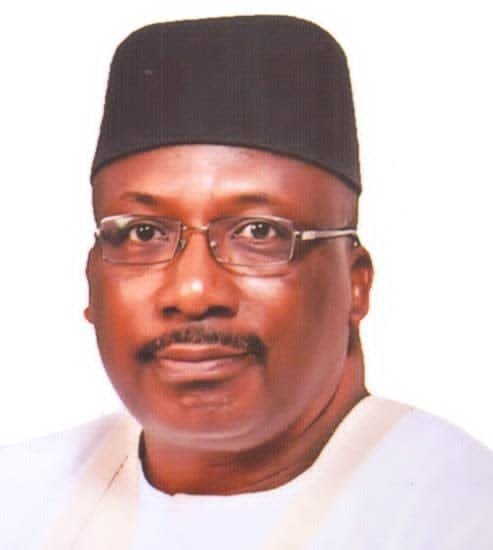
The Quiet Architect: Dambazau’s Legacy of Institutional Reform
 By Mohammed Manga
Under the ancient baobab of Zazzau at dusk, where generations have weighed wisdom, the elders teach that “you do not judge a farm by the bustle of its clearing, but by the fullness of its barn at harvest.” They also say, “A well is not praised because it was dug deep, but because it never runs dry when the people thirst.”
Such is the test of a nation. Not the elegance of its declarations or the flourish of its ceremonies, but whether its systems endure, its processes are fair, and the ordinary citizen can find dignity without knowing someone at the top. The true measure of a state is what works when no one is watching.
As Heraclitus observed, “No man ever steps in the same river twice, for it is not the same river and he is not the same man.” Institutions are those rivers. They must keep flowing even when personalities change, lest society run dry.
Nigeria, at 66, stands at a historic confluence. As the Yoruba say, “Bi omi ba ku, a fi oju ana e wo” — when water dries up, we study its former path. Our own path is instructive.
Long before amalgamation, governance in these territories had form and fidelity. In the Sokoto Caliphate, the Emir led, the Waziri administered, and the Alkali dispensed justice. In Oyo, the Alaafin ruled, but the Oyomesi checked his authority. Colonialism disrupted these indigenous systems, and independence tasked us with building modern institutions from near scratch.
Yet, as Professor Claude Ake warned, “the state in Africa has tended to become privatized.” To return it to the people, as the Igbo adage reminds us, “one finger cannot lift a load.” We need builders, not just occupants.
Global experience illuminates the path. Lee Kuan Yew transformed Singapore by insisting that “we have to re-invent ourselves continuously.” Malaysia transformed its commodity-based economy into an industrial powerhouse by disciplining its bureaucracy. Botswana built one of Africa’s most trusted public services by insulating its institutions from patronage. Rwanda rebuilt its judiciary after conflict by enforcing case timelines. The United Arab Emirates transformed desert outposts into efficient service hubs by measuring service delivery and publishing results.
As Dag Hammarskjöld taught, “It is more noble to give yourself completely to one individual than to labour diligently for the salvation of the masses.” Institution-building demands that same level of dedication.
It is at the level of everyday encounters with the state, where dignity is either affirmed or denied, that public trust is won or lost. Citizens may applaud macroeconomic reforms, but they ultimately judge government by the courtesy they encounter at the counter and the reliability of services when no one is watching.
Viewed through this lens, the public service career of Lt.-Gen. Prof. Abdulrahman Bello Dambazau, a soldier, scholar, reformer and diplomat, offers a compelling case study.
His story began not in power, but in preparation. Born on March 14, 1954, in Zaria, he received his early education at Barewa College before proceeding to the Nigerian Defence Academy as a member of the 17 Regular Combatant Course. He was commissioned as a second lieutenant in June 1977.
He refused to let khaki limit his pursuit of knowledge. He earned a Bachelor of Science degree in Criminal Justice, a Master of Arts degree and a Master of Education degree from Kent State University in the United States, as well as a PhD in Criminology from the University of Keele in the United Kingdom. He thus became Nigeria’s first Chief of Army Staff to hold a PhD.
For 33 unbroken years, he served with distinction. His career included appointments as Aide-de-Camp to the Chief of Army Staff in 1979; commander of Military Police units; Special Investigator from 1984 to 1985; Registrar of the Nigerian Defence Academy from 1993 to 1999; Chief Instructor at the Infantry Centre and School; Directing Staff at the National War College; General Officer Commanding (GOC), 2 Division, Ibadan, from 2007 to 2008; and Chief of Army Staff from 2008 to 2010.
Along that path, he laid the foundation for the Counter-Terrorism and Counter-Insurgency Centre in Jaji and authored five seminal books, including Criminology and Criminal Justice. His academic distinctions included serving as a Senior Fellow at the University of Massachusetts, Boston, and an Associate at Harvard University’s Weatherhead Center for International Affairs. He also served as Chairman of the University Advancement Centre at the University of Ibadan.
He currently serves as Pro-Chancellor and Chairman of the Governing Council of Capital City University, Kano.
In November 2015, President Muhammadu Buhari called him to what was perhaps his most challenging assignment: Minister of Interior.
He inherited four agencies where morale was low and public cynicism was high: the Nigeria Immigration Service, the Nigeria Prisons Service (now the Nigerian Correctional Service), the Nigeria Security and Civil Defence Corps, and the Federal Fire Service.
Many regarded it as a thankless ministry. He treated it as a laboratory for reform.
What does a scholar do with such a portfolio? He chose systems over slogans.
First, he professionalised the service. He introduced comprehensive reforms aimed at creating seamless pathways for career progression, training, appointments and promotions.
Second, he digitised operations. He introduced biometric systems, digitalised the international passport process, deployed Advance Passenger Information in collaboration with INTERPOL, and advocated local passport production to reduce costs and strengthen the security of the national database.
Third, he humanised the correctional system. He pursued reforms aimed at reducing congestion involving awaiting-trial inmates, procured operational vehicles, initiated plans for model custodial centres with a capacity of 3,000 inmates, and helped midwife the new Correctional Act, shifting the emphasis from punishment to rehabilitation in line with the United Nations Standard Minimum Rules for the Treatment of Prisoners, commonly known as the Nelson Mandela Rules.
Fourth, he revived neglected institutions. At the time, the Federal Fire Service reportedly had fewer than three functional fire trucks in Abuja. He oversaw efforts to revitalise the service, increasing its fleet to more than 40 modern fire trucks and water tankers. The reforms also included the establishment of six zonal headquarters and the reactivation of its training school.
Fifth, he institutionalised coordination. He established a Situation Room for emergency coordination, led the US-Nigeria Security Sector Reform Dialogue, conceptualised the Institute of Domestic Security for the strategic training of senior officers, and instituted the Interior Games to promote collaboration among agencies under the ministry.
Beyond his work in uniform, Dambazau’s commitment to public safety and justice extended to victim advocacy. As a criminologist, he founded the Foundation for Victims of Child Abuse and the Nigerian Society of Victimology, affirming that the supreme art of governance lies in preventing harm, often without fanfare.
Today, that same depth of preparation and demonstrated capacity for institution-building has taken him to Beijing as Nigeria’s Ambassador to China, one of the country’s most strategic diplomatic postings.
What, then, is the enduring lesson?
If a scholar in uniform could transform four agencies often dismissed as moribund into institutions that now touch millions of lives with dignity — issuing passports with fewer frustrations, responding to fires with greater capacity, and securing borders through data — what prevents us from replicating that quiet architecture elsewhere?
If effective processes can replace patronage in the Ministry of Interior, they can do the same in primary healthcare centres, where medicines must be traceable; in public schools, where promotions must be merit-based; in power distribution, where metering must be transparent; and in local councils, where budgets must be published.
This article is not a eulogy. It is a mirror held up to all who serve and all who exercise oversight: political officeholders who formulate policies; legislators charged with oversight; heads of agencies who steer the machinery of the state; permanent secretaries and directors who safeguard institutional memory; and our revered members of the Bench, who serve as guarantors of justice.
The question remains: Are we leaving our institutions better than we found them?
Nigeria does not need louder government. It needs stronger institutions — systems that deliver when no one is applauding and endure long after the individuals who built them have left.
As Einstein said, “Strive not to be a success, but rather to be of value.” And as Professor Ali Mazrui reminded us, “Africa’s greatest challenge is not the absence of ideas, but the absence of institutions to carry those ideas.”
May the lesson of the quiet architect endure: build quietly, reform boldly, and leave the ladder down for others to climb.
Mohammed Manga is a public policy analyst who writes on governance and subnational reforms. He can be reached via mohammed.manga.policy@gmail.com.

