
Benue 2026 Budget: A Turning Point For Rural Dwellers
By Bridget Tikyaa


Budget presentation is not just an annual ritual, but a time of reflection, a time to review the facts, assess performance, set the records straight and unveil a new focus to expand opportunities and development and a new performance target.
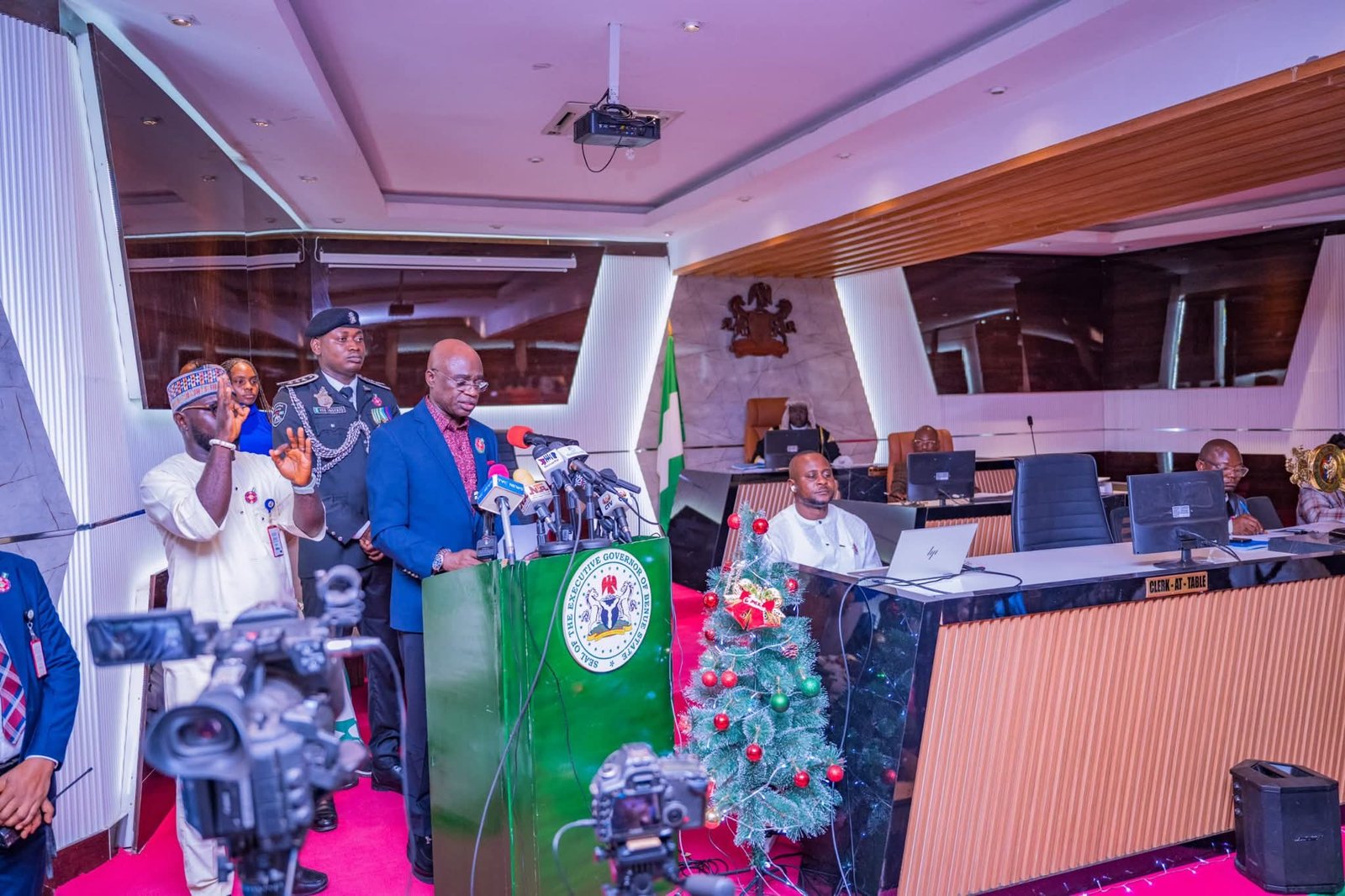
This is what Governor Hyacinth Iormem Alia of Benue State did on Monday, December 22, 2025, when tabled the state’s 2026 budget of N605 billion, which is aptly christened as the “Budget of Human Capital Development, Food Security and Digital Economy”. It is the third budget prepared by the administration which came into office on May 29, 2023, an administration that has transformed Benue State, exposed deceptive leaders and lies of the past, created opportunities for businesses and growth, and completely revolutionised infrastructure, the rural economy, the civil service, which is the engine room of government, and restored hope and dignity to pensioners, displaced persons and the vulnerable in the society.
It is with this buoyed successes that the government set to focus on Rural Development, Livelihood Support and Sustained Growth in 2026. This is not only apt but necessary because the Benue story is fundamentally a rural story. A story of farms, small towns, riverine communities, and local markets that define the state’s economy and the daily lives of the people. This made it imperative for the Benue State Government to focus on this vast economy and people that not just feed the nation, but also hold the potential for inclusive prosperity.
“For too long, these communities have borne the weight of underinvestment. Today, we turn that page,” the governor declared as he stared into the future and the enormous task of the next twelve months to deliver set promises for the transformation of the rural economy.
The 2026 Budget is built on the principle that rural transformation is the engine of state-wide development, the prioritization of livelihood support for vulnerable households, rebuilding the productive base of the economy, expanding opportunities for youth and women, and fiscal discipline, transparency, and result-oriented governance. The budget is structured to drive practical improvements in the lives of ordinary people, particularly those in rural communities.
For the Benue State Government, teansforming the rural economy is not an option, but a necessity. The budget has therefore prioritise targeted investments in roads, infrastructure, and activities that will unlock rural productivity and improve quality of life. It contains phased rehabilitation and construction of feeder roads linking farming communities to major markets, processing clusters to distribution hubs, and rural areas to health and educational facilities. When transportation is made easier, it helps to reduce post-harvest losses, lower transport costs, and stimulate local commerce.
The government has allocated a total of 30.23% of the capital budget to the development of rural roads, feeder roads, and bridges, so as to connect farmers to markets, children to schools, and communities to essential services.
The budget will also focus on three other key areas – Rural Electrification, Water Supply, and Environmental Protection. Provisions have been made for the expansion of solar and mini-grid electricity in rural settlements, new water systems and boreholes to provide potable water to communities that have long relied on unsafe sources, especially those affected by displacement or infrastructure decay. Additionally, given the increasing threats of floods and environmental degradation, the budget expands watershed protection programs, tree-planting initiatives, and climate-smart agriculture investments, which pave the way for climate resilience and environmental protection. This is allocated 12.61% of the capital budget.
In the area of Agriculture and Agro-Industrial Development, which has been allocated 17.62% of the capital votes, the government will continue to subsidise farm inputs, improve seeds distribution, provide mechanization support through tractor-hiring schemes, expand extension services and digital advisory platforms, and develop aggregation centers and cottage processing plants across zones. The goal is to stimulate agro-industrial value chains that generate jobs and higher incomes.
The Alia administration believes very strongly that economic growth must improve households welfare, felt in every household, otherwise it is meaningless. In 2026, 14.11% of the capital budget has been earmarked to expand livelihood programmes that protect the vulnerable, empower the youth, and elevate women. Development must be inclusive, and that is what Governor Alia has consistently shown.
This is evident in the allocation of 3.65% of the capital budget for Social Protection Programmes. The programmes will strengthen targeted support to elderly citizens, persons with disabilities, internally displaced persons, and extremely vulnerable households. Cash transfers, community support grants, and livelihood kits will be delivered through verifiable and transparent channels. The government believes that intervening in Women and Youth Empowerment as an integral and critical component of these programmes will unlock local productivity.
Specifically, the government will establish Women Enterprise Support Grants, expand Technical and Vocational Education and Training (TVET) centers, support youth cooperatives in agriculture, ICT, and creative industries, and provide low-interest financing through micro-credit schemes. “Our expectation is geared toward reaching at least 1,000 beneficiaries in each of our 276 wards to reduce poverty and unemployment,” Governor Alia said. That is 276,000 women and youth across Benue State.
The 10.46% allocation in the 2026 budget will scale up assistance for micro, small, and medium enterprises (MSMEs). It is a recognition that MSMEs remain the backbone of community commerce. This budget introduces affordable interest credit through NOVUS bank, grants for women-led enterprises, capacity-building for cooperatives, especially in agriculture, agro-processing, and crafts, business development training, improved access to rural finance, cooperative strengthening programmes, and market-linkage initiatives.
To ensure sustained growth, the government has set deadlines for projects completion. It has ensured that no new project is started unless ongoing ones have reached at least 75%, to maximize impact and fiscal efficiency. The government has maintained very strong discipline in fiscal responsibility and revenue optimization, and has plug leakages, and expand internally generated revenue through automation, without imposing undue burdens on citizens. In other words, the budget has reinforce the government’s prudence in financial management.
Allocations have been made to strengthen innovation and digital transformation by providing digital infrastructure in rural communities to benefit from e-commerce, e-health, e-education, and modern public services. This is critical to bridging the rural–urban divide.
In the area of Education and Health, the government will in 2026 sustain the upgrade of primary and secondary schools, train teachers, and provide learning materials, improve primary and secondary healthcare delivery, strengthen immunization, maternal health programmes, and improve life expectancy. In the areas of Infrastructure for Long-Term Competitiveness, key investments will be directed to completing ongoing road and bridge projects, improving water and sanitation infrastructure, and facilitating private-sector-led housing and industrial projects.
“To ensure a government that works for the people, we will intensify reforms in civil service efficiency, digitalization of government processes, open budgeting and public accountability, and stronger local government administration. These reforms will improve service delivery and strengthen citizens’ trust in government,” Governor Alia said.
Bridget Tikyaa is the Principal Special Assistant to GovernorHyacinth Alia on Media, Publicityand Communications Strategy