

Jigawa launches wheat value chain research programme, awards grants to 10 scholars
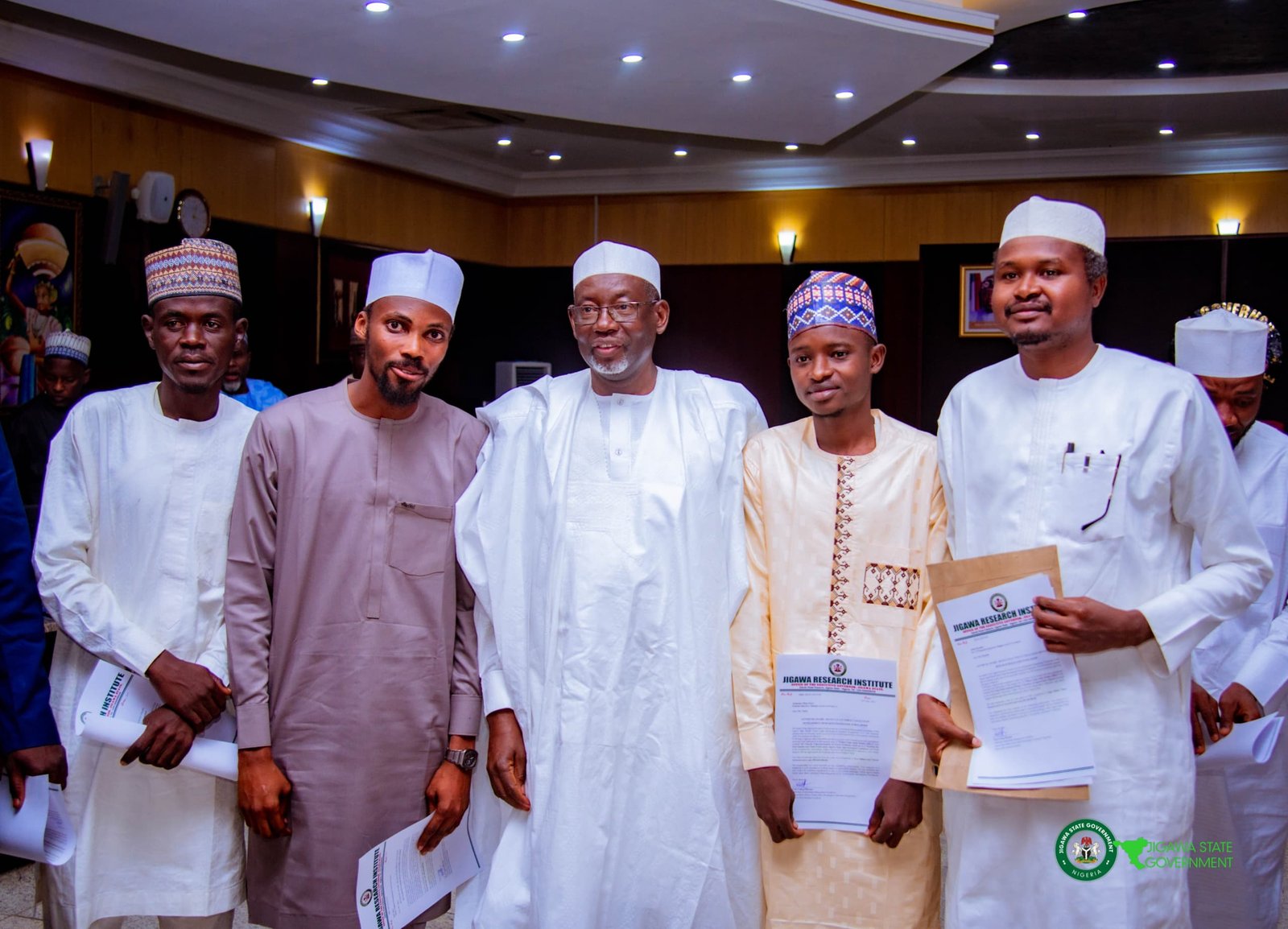
The Jigawa State Government has launched a Wheat Value Chain Research Programme—the first of its kind in the country—and awarded research grants to ten postgraduate scholars—four PhD and six MSc candidates, as part of its continuing efforts to modernize agriculture through research, innovation, and human capital development.
The grants award ceremony was presided over by Governor Malam Umar Namadi, Wednesday,at the Council Chambers of the Government House, Dutse.
Jigawa State is the leading producer of wheat in the country, and the initiative followed a statewide invitation for research proposals and a rigorous, merit-based selection process.
Speaking at the presentation of the awards, Gov. Umar Namadi described the programme as a strategic intervention designed to support innovation and evidence-based policymaking in agriculture.
“This initiative is timely and important, especially considering global developments and the growing need for food security,” the governor said.
He congratulated the beneficiaries on their selection, stating that their research would build on existing efforts to expand wheat production and strengthen agribusiness in Jigawa State.
“Your selection has shown that you are intelligent, capable, and ready to partner with the government in advancing agriculture, which remains a critical sector for our state. We sincerely appreciate your commitment and encourage you not to relent in your efforts.”
The governor praised the selection committee for conducting what he described as a fair and transparent exercise, adding that the quality and caliber of the selected scholars reflected the seriousness of the
programme.
He assured the beneficiaries that the state government is ready to implement the outcomes of their research, stressing that the initiative is expected to deliver practical solutions that will benefit farmers and support the state’s broader agricultural development agenda.
Governor Namadi also expressed appreciation to the Committee on the Wheat Value Chain Development Program and the Jigawa Research Institute for their commitment and collaboration, describing them as
reliable partners in the state’s agricultural transformation efforts.
He urged the beneficiaries to devote the required time, discipline, and intellectual rigour to the assignment, emphasizing that their findings would serve as a foundation for future policies and programmes in the sector.
Earlier, the Chairman of the Committee on Wheat Value Chain Development Programme, Professor Usman Haruna, explained that the initiative was informed by the central role of agriculture in Jigawa State, where about 80 percent of the population depends on farming and
related activities for their livelihoods.
He identified wheat as a strategic crop with strong potential for income generation and food security but noted that production has been constrained by limited research capacity, inadequate locally adapted
seed varieties, and insufficient scientific support.
“Wheat, in particular, has great potential in Jigawa State. However, our ability to produce wheat in large quantities has been constrained by several factors. These include the lack of adequate and improved wheat varieties suitable for our environment, as well as the shortage of research scientists capable of conducting in-depth research in wheat production.
“It was against this background that the Jigawa Research Institute designed this programme to build the capacity of young scientists to undertake research aimed at developing the wheat value chain in Jigawa
State.”
Professor Haruna disclosed that 36 applications were received in response to the call for proposals, out of which 17 candidates met the criteria and were invited for interviews.
“The committee designed a robust and transparent interview process, and at the end of the exercise, 10 candidates emerged successful. These candidates were therefore recommended for the award of scholarships to conduct research on wheat value chain development in Jigawa State.”
He explained that the selected scholars will focus on critical areas across the wheat value chain, including seed development adapted to Jigawa’s climatic conditions, productivity enhancement, and value addition.
According to him, strengthening research capacity in wheat production will not only improve Jigawa State’s output but also contribute meaningfully to meeting national wheat demand.
“This initiative will not only impact wheat production but will also have positive spill-over effects on other crops such as rice and sorghum, which Jigawa State is well known for cultivating. The state has enormous agricultural potential, and the government has continued to support value chain development across various crops, including rice, sesame, and wheat.”
“With these young researchers now in place, we are confident that viable wheat seed varieties adapted to Jigawa’s climatic conditions will be developed. This will improve productivity, boost farmers’ yields, and ultimately increase the state’s contribution to the national wheat supply.”
The programme’s research areas include Wheat Seeds Development Research, Wheat Value Chain Studies, and Wheat Irrigation Efficiencies, and will be implemented in partnership with leading research institutions and universities, such as Federal University Dutse, Sule Lamido University in Kafin-Hausa, Bayero University Kano, the Institute for Agricultural Research (IAR) in Zaria, and the Lake Chad Research Institute.
Jigawa launches wheat value chain research programme, awards grants to 10 scholars