
Shettima Unveils 10,000 Electric Vehicles in North-East, NEDC Plans 100,000 Fleet, Airline, Pharmaceutical Firm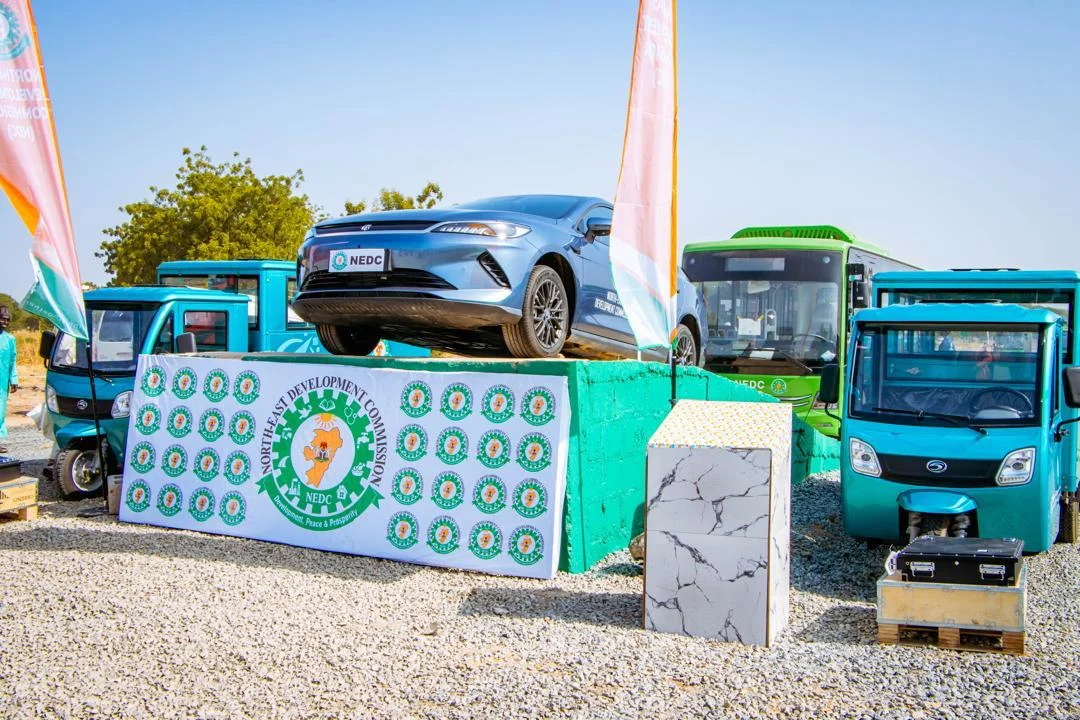
…As FG steps up post-insurgency reconstruction, targets 50MW solar power, infrastructure renewal
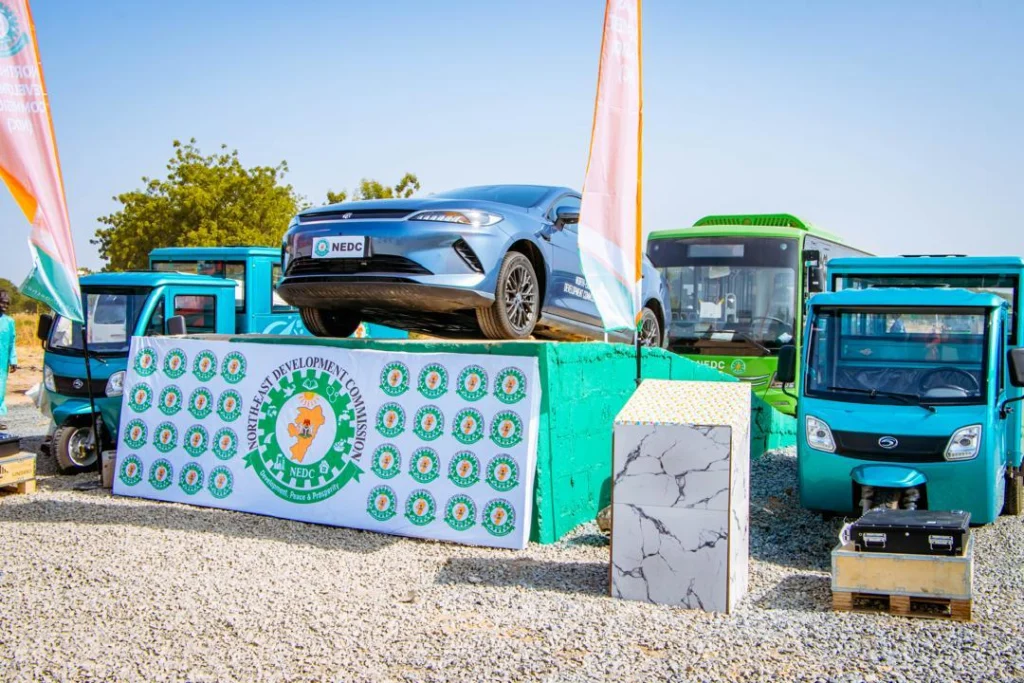
Vice-President Kashim Shettima on Tuesday unveiled 10,000 electric vehicles in Maiduguri, Borno State, as the Federal Government intensified efforts to rebuild the North-East, with the North-East Development Commission (NEDC) announcing plans to expand the fleet to more than 100,000 vehicles across the region.
The ambitious electric mobility programme, alongside plans to establish a regional airline and pharmaceutical company, signals a fresh push to transform the North-East from a region devastated by years of insurgency into an emerging centre of economic activity, industrial development and renewable energy investment.
The initiatives formed part of a series of development projects commissioned by Shettima in Maiduguri, covering transportation, roads, education, healthcare, agriculture, energy and humanitarian support, in what officials described as a significant milestone in the region’s reconstruction efforts.
The proposed expansion of the electric vehicle scheme, coupled with a planned 50-megawatt solar mini-grid project, also places renewable energy at the centre of the NEDC’s development strategy, particularly as the region seeks alternatives to expensive petrol-powered transportation and unreliable electricity supply.
Speaking at the commissioning ceremony, Shettima challenged governments and communities in the North-East to take advantage of the region’s abundant sunshine to develop solar energy and other alternative power sources.
He described electric mobility as essential to the region’s development, noting that the initiative would reduce dependence on petrol, ease transportation difficulties and support the transition to cleaner energy.
The Vice-President commended the NEDC and governors of the six North-East states for their contributions to the region’s recovery but stressed that the battle against Boko Haram insurgency, banditry and other security threats required sustained cooperation.
He called for greater unity among political leaders and stakeholders, insisting that the region’s development aspirations could only be achieved in an atmosphere of peace and stability.
The Minister of Regional Development, Abubakar Momoh, said the electric vehicle initiative was consistent with President Bola Tinubu’s Renewed Hope Agenda and would provide affordable transportation for women, youths, traders and farmers.
He said the intervention was designed not merely to improve mobility but also to stimulate commercial activities, support livelihoods and create opportunities for economic growth.
Momoh also highlighted the Jere Bowl road project, which is expected to improve access to agrarian communities and facilitate the transportation of agricultural produce, alongside the proposed 50-megawatt solar mini-grid initiative.
In a further indication of the commission’s long-term economic ambitions, the Minister of State for Regional Development, Uba Maigari Ahmadu, disclosed plans to establish an airline and a pharmaceutical company for the North-East.
The proposed investments are expected to broaden the region’s economic base, strengthen connectivity and create opportunities in the aviation and pharmaceutical sectors.
Borno State Governor and Chairman of the North-East Governors Forum, Babagana Zulum, said the region was gradually recovering from years of insecurity through rehabilitation, resettlement, innovation and infrastructure development.
Zulum, who commended the NEDC for its interventions, said the commission had made remarkable contributions to rebuilding communities and restoring hope among residents affected by the insurgency.
“No other government agency did what you have done,” the governor declared.
He expressed appreciation to Tinubu and Shettima for their support for the region, urging the Federal Government to sustain its commitment to security, reconstruction and economic recovery.
Gombe State Governor, Inuwa Yahaya, also praised the Federal Government for establishing regional development commissions, describing them as important institutions for addressing the peculiar development challenges confronting different parts of the country.
He commended the NEDC’s electric mobility programme and reaffirmed the commitment of governors in the region to collective action in advancing development.
Earlier, NEDC Managing Director, Mohammed Ali Alkali, said Shettima’s visit was not merely to console the people over the devastation caused by insurgency but also to witness the achievements and resilience of a region determined to rebuild itself.
Alkali said the 10,000 electric vehicles would help reduce dependence on petrol and ease transportation difficulties, while the commission was also investing in human capital development through skills acquisition programmes and scholarships.
He listed the commission’s interventions to include the construction and rehabilitation of roads and bridges, schools, hospitals, provision of medical equipment, boreholes, agricultural support, humanitarian assistance and livelihood programmes for vulnerable communities.
The managing director commended Tinubu for providing the funding and institutional support required to execute the commission’s development programmes.
The North-East, comprising Borno, Adamawa, Yobe, Bauchi, Gombe and Taraba states, has endured more than a decade of insurgency, particularly from Boko Haram and its splinter factions, resulting in widespread destruction of infrastructure, displacement of millions of people, disruption of agriculture and the collapse of economic activities in several communities.
The crisis has made reconstruction, rehabilitation and resettlement major priorities for governments and development partners, with Borno bearing a particularly heavy burden of the conflict.
Established to coordinate and accelerate the recovery of the region, the NEDC has been implementing interventions aimed at rebuilding critical infrastructure, restoring livelihoods, improving access to education and healthcare and addressing the development deficits that have compounded insecurity.
The latest projects underscore the growing emphasis on moving beyond emergency humanitarian interventions towards long-term economic recovery.
However, the success of the ambitious electric mobility programme and proposed investments in aviation, pharmaceuticals and solar energy will ultimately depend on effective implementation, sustainable financing, adequate infrastructure and the restoration of lasting security across the region.


Comments