
Jigawa partners NDDB India to boost dairy production
By Editor 
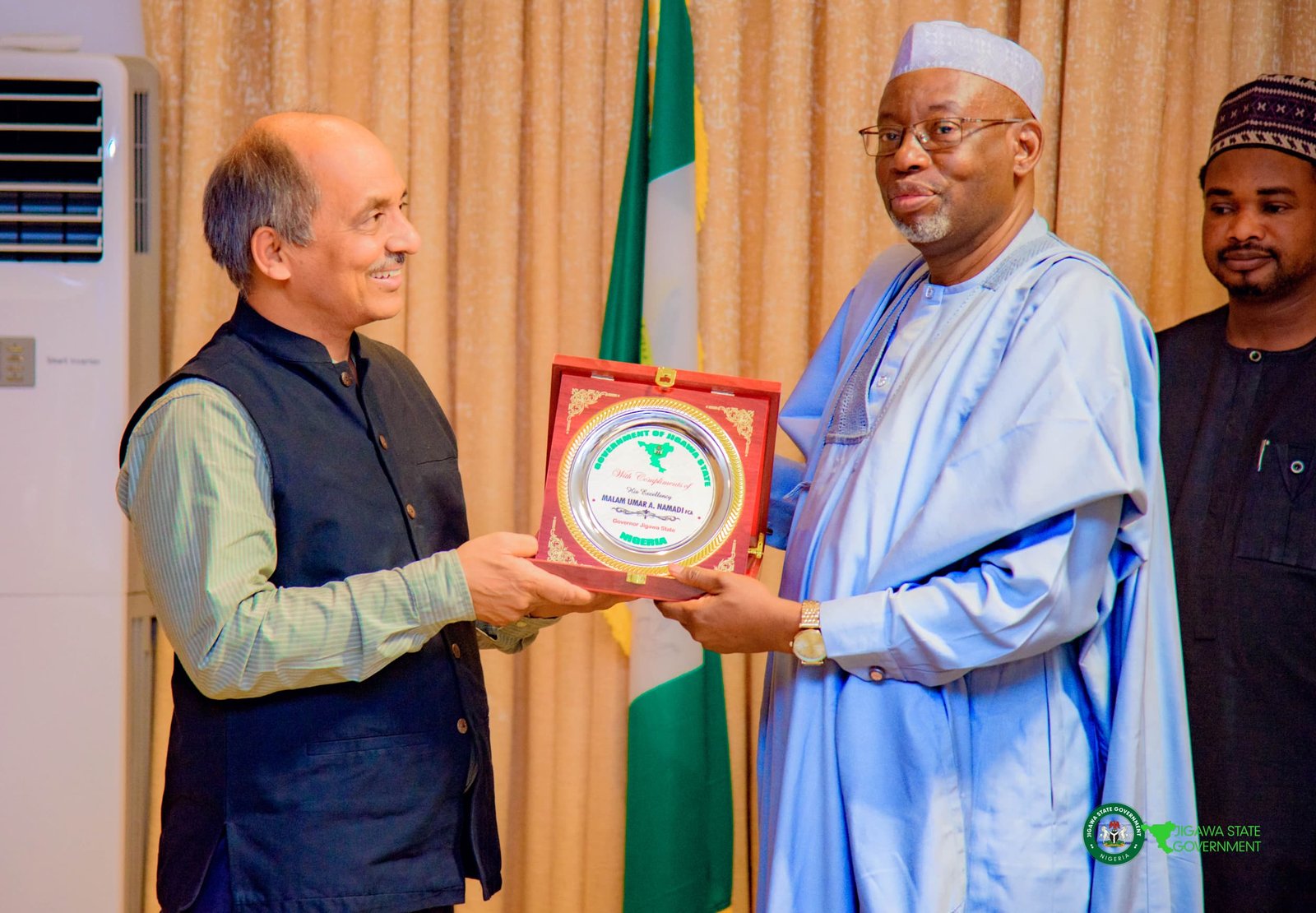
The Jigawa State Government is exploring a strategic partnership with the National Dairy Development Board (NDDB) of India with the focus of strengthening livestock development and expanding dairy production across the state.
Gov. Umar Namadi disclosed this while receiving a high-powered delegation from the NDDB, led by Mr. Rajesh O. Gupta, on a courtesy visit to Government House, Dutse.
The visit follows the Governor’s earlier engagement with Indian dairy institutions during his official visit to India sometime last year, where discussions were initiated on possible areas of collaboration to transform Jigawa’s livestock sector.
Welcoming the delegation, Namadi described the visit as highly important for the state’s agricultural development, saying that the engagement with NDDB forms part of the state government’s broader strategy to reposition the livestock sector and improve the livelihoods of farmers and pastoral communities.
“This visit, we consider it very, very important because this visit is following our visit to India, where we had discussions with NDDB management. Part of the agreement we did at that time was that your team will visit, so your coming today has justified that agreement,” the Governor said.
Namadi stated that the climatic similarities between India and Nigeria make it possible for Jigawa State to learn from India’s successful dairy development model.
“And what we have also seen when we were in India is that the climatic condition of India and Nigeria is almost the same. So it means whatever we want to do, climate will never be a problem because the climate condition is almost the same.”
The governor also stressed the importance of adopting elements of India’s cooperative-based dairy system, which has helped transform the country into the world’s largest milk producer.
“NDDB has really transformed the dairy industry in India, and from what we have seen when we were there, I think it is something that we also need to copy and replicate here.”
Namadi emphasized that improving livestock genetics through cross-breeding and artificial insemination would significantly increase milk production in the state.
“You see a cow is not producing up to one litre of milk. But now, with what we are trying to do with the cross-breeding and the improvement of genetics, the volume of production will definitely be very high,” he stated.
He assured the delegation that the Jigawa State Government is ready to invest in knowledge transfer and capacity development for local scientists and extension workers to support dairy sector reforms in the state.
“We are ready to send as many of our scientists as possible to India because knowledge is power. In India, you can have 300 scientists serving farmers in a district. It is unbelievable. Here at the ward level, we already have about five extension workers serving farmers, so it is something we can replicate.”
Namadi also reaffirmed the state government’s commitment to fast-tracking the partnership process, adding that the administration is expecting a comprehensive proposal from NDDB to guide the next phase of collaboration.
“We expect to have a comprehensive proposal from you by the end of this month or the first week of next month. Once we get the proposal, we will swing into action,” he added.
Earlier in his remarks, the team leader of the delegation, Mr. Rajesh O. Gupta appreciated the Jigawa State Government for the opportunity to visit the state and study its livestock ecosystem.
He said the team’s two-day field visits had provided useful insights into existing livestock practices and opportunities for dairy sector development.
He explained that India’s dairy success was the result of sustained interventions across the entire value chain, including animal breeding, farmer organisation, processing, and technology.
“If you look at the Indian dairy system, we are the number one producer in the world. We produce almost 247 million metric tons of milk annually,” he stated.
The NDDB delegation also expressed readiness to support Jigawa State through technical cooperation, capacity development for scientists and extension workers, and the development of pilot dairy projects that could serve as models for wider expansion across the state.
Jigawa partners NDDB India to boost dairy production