

PAVE Advocates Rights-Based Community Engagement to Counter Violent Extremism
By: Ahmed Aminu, Dutse
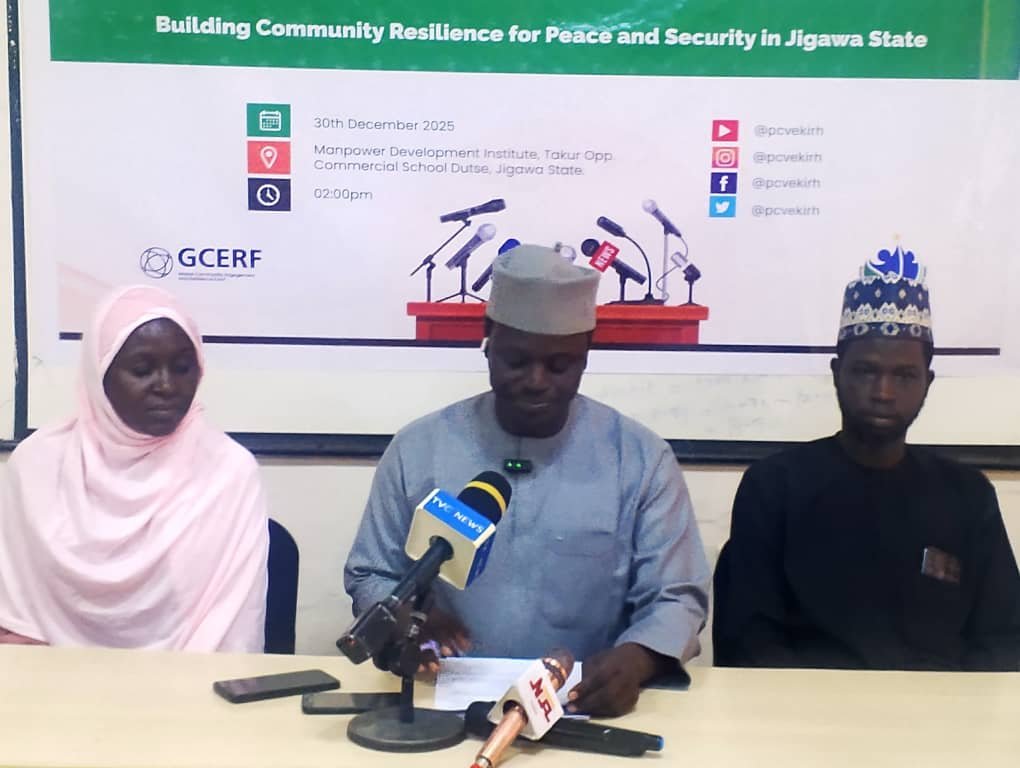
The Partnership Against Violent Extremism (PAVE) Network has called on security agencies to intensify community engagement while strictly adhering to human rights and the rule of law in efforts to prevent and counter violent extremism.
The call was made by the Chairman of the Jigawa State chapter of PAVE, Comrade Muhammad Musbahu Basirka while briefing journalists on the organisation’s activities in the state.
According to him, strict adherence to human rights by security personnel would promote and strengthen synergy and cordial relations with the general public.
Basirka disclosed that PAVE recently concluded a 15-day Community Resilience Campaign across selected local government areas of Jigawa State, focused on peace education, tolerance, conflict awareness and the strengthening of community networks aimed at countering extremist narratives.
He explained that the engagements revealed a growing level of awareness among community members, as well as an increased willingness to take collective responsibility for peacebuilding and social cohesion.
Basirka noted that the collective efforts of stakeholders have yielded notable gains in Jigawa State, including strengthened multi-sector collaboration among ministries, departments and agencies (MDAs), security agencies, civil society organisations and host communities.
He added that there has been progress towards the development of State and Local Action Plans (SAPs and LAPs) aligned with the National Policy Framework and National Action Plan on Preventing and Countering Violent Extremism (PCVE).
Other achievements, he said, include the establishment and operationalisation of Technical Working Groups on PCVE, improved community-level early warning and response awareness, increased inclusion of PCVE considerations in state development discourse and budget proposals, as well as growing engagement of non-traditional stakeholders, including the private sector.
According to him, these gains present opportunities for deeper youth engagement, targeted livelihood interventions and the institutionalisation of PCVE within government systems.
Despite the progress recorded, Basirka acknowledged that significant challenges remain. These include the continued regional presence of armed and criminal groups, socio-economic vulnerabilities,particularly among young people, uneven early warning and intelligence linkages at the local government level, and gaps in fully mainstreaming PCVE priorities across sectoral budgets.
He stressed that the challenges underscore the fact that preventing and countering violent extremism is not the responsibility of a single institution, but a shared task requiring coordinated governance and broad societal participation.