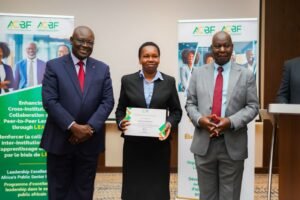

ACBF, Gates Foundation Urge African Governments to Invest in Leadership for Sustainable Reforms
…Say technical expertise alone cannot transform public institutionsBy Michael Olugbode
The African Capacity Building Foundation (ACBF) and the Bill & Melinda Gates Foundation have called for increased investment in leadership development across Africa’s public sector, saying technical expertise, sound policies and institutional systems alone cannot deliver sustainable reforms.
They made the call on Thursday at a webinar organised by ACBF on “Leading Public Sector Transformation in Africa: Leadership Lessons from the LEAPS Programme,” where participants examined how leadership capacity could help governments overcome resistance, strengthen public financial management (PFM) and translate reforms into measurable institutional results.
Executive Secretary of ACBF, Mr. Mamadou Biteye, said public-sector reform was rarely constrained by a shortage of good ideas, but more often by the ability to lead change, build trust, bring stakeholders together, overcome resistance and sustain momentum.
He said African governments were undertaking ambitious PFM reforms aimed at mobilising domestic resources, improving public investment, strengthening budgeting and enhancing expenditure management.
However, he noted that progress remained uneven, with leadership, coordination and implementation continuing to rank among the continent’s major capacity challenges.
According to him, this was the rationale behind the establishment of the Leadership Excellence for Africa’s Public Sector (LEAPS) programme by ACBF, with support from the Gates Foundation.
Biteye said the programme was founded on the recognition that while technical expertise was essential, it was insufficient to deliver complex institutional reforms.
“Reform leaders must do more than understand systems; they must inspire people, build trust, navigate competing interests, manage resistance, and sustain momentum when reforms become difficult,” he said.
He explained that LEAPS moves beyond conventional training by combining structured leadership learning with self-assessment, personal development plans, individual and group coaching, peer learning, technical seminars and case-based application to real PFM challenges.
Senior Programme Officer, Development Policy and Finance at the Gates Foundation, Mr. Adil Ababou, said the experience of working with ACBF on LEAPS had reinforced three major lessons about public-sector reform.
He said the first was that institutions and systems do not reform themselves; people lead reforms.
Ababou said many of the most difficult challenges facing public finance officials were not purely technical, but involved building consensus around difficult reforms, managing resistance, working across institutional boundaries and sustaining momentum when political or economic circumstances changed.
He said this was particularly important for public finance because the decisions of ministries of finance, revenue authorities, treasuries and other public institutions ultimately determine governments’ ability to fund schools, healthcare, social protection and other services.
“In the context of abrupt aid cuts, government finance is now, more than ever, the backbone of sustained and nationally owned development,” he said.
Ababou identified ownership as the second major lesson from the LEAPS experience, explaining that the programme was deliberately designed not to impose predetermined reforms or solutions on participating countries.
Instead, he said, the approach begins by understanding the capacity needs of participating institutions, after which participants receive sustained coaching while retaining responsibility for defining the problems they want to address and the objectives they want to achieve.
He said this was increasingly important as African countries placed greater emphasis on sovereignty, policy ownership and defining their own development priorities.
His third lesson was that leadership could not remain an individual capability.
“Successful reform requires teams, institutions and networks of officials who are able to work across the administrative silos that often characterise government,” he said.
Ababou noted that individual reformers could have much greater impact when their institutions gave them the space to act, senior leaders supported them and they were able to build coalitions around change.
“That is when individual leadership can start generating institutional momentum,” he said.
The LEAPS programme, a six-month executive leadership development initiative delivered through ACBF’s Ubora Academy, has enrolled more than 295 participants across eight African countries since its launch in 2024.
The countries reached are Côte d’Ivoire, The Gambia, Ghana, Kenya, Nigeria, Senegal, Tanzania and Zimbabwe.
The programme combines self-paced online learning with live facilitated sessions, executive coaching, group mentoring, technical seminars and peer exchange.
Its five modules cover African leadership paradigms; self-awareness and emotional intelligence; leading high-performing and inclusive teams; driving strategic organisational change; and engaging stakeholders and driving systemic transformation.
Biteye said early evidence from the first cohort showed that participants were translating their leadership development into institutional improvements.
In Kenya, participants demonstrated how people-centred leadership could complement technical expertise in advancing digital PFM reforms and securing stakeholder alignment.
In Senegal, leadership development contributed to stronger delegation, participatory management and communication, including efforts to make budget information more accessible to citizens.
In Ghana, coaching strengthened accountability, goal-setting and collaboration between finance and audit institutions, while in Zimbabwe, reflective and empathetic leadership practices helped officials navigate complex reforms under difficult institutional and resource constraints.
“These are not simply training outcomes; they are examples of leadership changing how institutions work,” Biteye said.
Ababou similarly said experiences from the first cohort were showing consistent changes, including greater delegation, improved communication, more participatory management, stronger cross-institutional collaboration and more deliberate listening and empathy.
He disclosed that an external evaluation of the programme was currently ongoing.
The impact of the programme was also reflected in testimonials from alumni, including Dr. Oluwole Olutola, Deputy Director at the Budget Office of the Federation, Ministry of Finance, Nigeria.
Olutola said LEAPS had changed his understanding of leadership from one centred on position and title to one based on shared responsibility.
“My understanding of leadership is shared leadership, collaborative leadership. It is no longer about position. It is no longer about title. It is no longer about office. It is about collective decision and collective responsibility,” he said.
He added that he now held regular meetings with his teams and ensured that members contributed to decisions.
Ana Awotwe Bosumafi, Assistant Auditor General of the Ghana Audit Service, said the programme made her realise that she still had considerable room for leadership growth.
Priscilla Maina, Director of Audit at Kenya’s Office of the Auditor General, said LEAPS helped her overcome her tendency to do everything herself and learn to trust others.
Lou Drinan Sylvie Epse Dah of Côte d’Ivoire’s Public Treasury said the programme strengthened her ability to manage her emotions, remain calm and show respect and consideration for colleagues.
The webinar also marked the formal launch of the LEAPS Change Story, titled Advancing Leadership Excellence in Africa’s Public Sector: Insights from the LEAPS First Cohort.
The publication documents participants’ leadership journeys, institutional outcomes and lessons across three cohorts and eight African countries.
It seeks to move beyond activity reporting by documenting what changed for individual leaders, how their institutions responded and what evidence exists on leadership development as a driver of public-sector reform.
Biteye said the experiences demonstrated the importance of developing leaders who could strengthen PFM institutions and improve public-sector delivery.
The event further marked the launch of the LEAPS Executive Leadership Programme, an expanded version of the initiative designed to make the programme available to public-sector and regional-body professionals across Africa.
The programme will provide a structured leadership journey incorporating online modules, live facilitated sessions, group coaching and mentoring, technical seminars, learning materials and an ACBF certificate.
According to ACBF, the programme represents an effort to expand access to continent-designed executive leadership development and build a sustainable pipeline of African public-sector leaders.
The programme is grounded in African leadership paradigms and case studies and is delivered in English and French.
Biteye said the next challenge was to ensure that leadership development did not remain an isolated opportunity for selected individuals.
He identified three priorities for the future: institutionalising leadership development; moving from individual transformation to institutional transformation; and sustaining and scaling what works.
He said LEAPS graduates should become mentors, reform champions and catalysts for wider changes in institutional culture.
The ACBF chief stressed that the Foundation was committed through LEAPS and the Ubora Academy to building a pipeline of African public-sector leaders who were technically competent, ethically grounded, collaborative and capable of leading change in complex environments.
Ababou similarly urged stakeholders to ensure that the gains made by individual participants were embedded in teams and institutions.
Biteye said the issue ultimately came down to the central role of people in reform.
“Systems do not reform themselves; budgets do not implement themselves; digital platforms do not transform institutions by themselves; and policies do not deliver results by themselves. People do,” he said.
He added that when people were equipped, inspired and supported, institutions could change.
ACBF, a specialised agency of the African Union established in 1991, has worked for more than three decades across more than 50 African countries to strengthen human and institutional capacity in areas including governance, public financial management, economic policy and leadership.
Through LEAPS, the Foundation is seeking to move leadership development from an individual training intervention into a broader institutional and continental reform strategy.
ACBF, Gates Foundation Urge African Governments to Invest in Leadership for Sustainable Reforms