
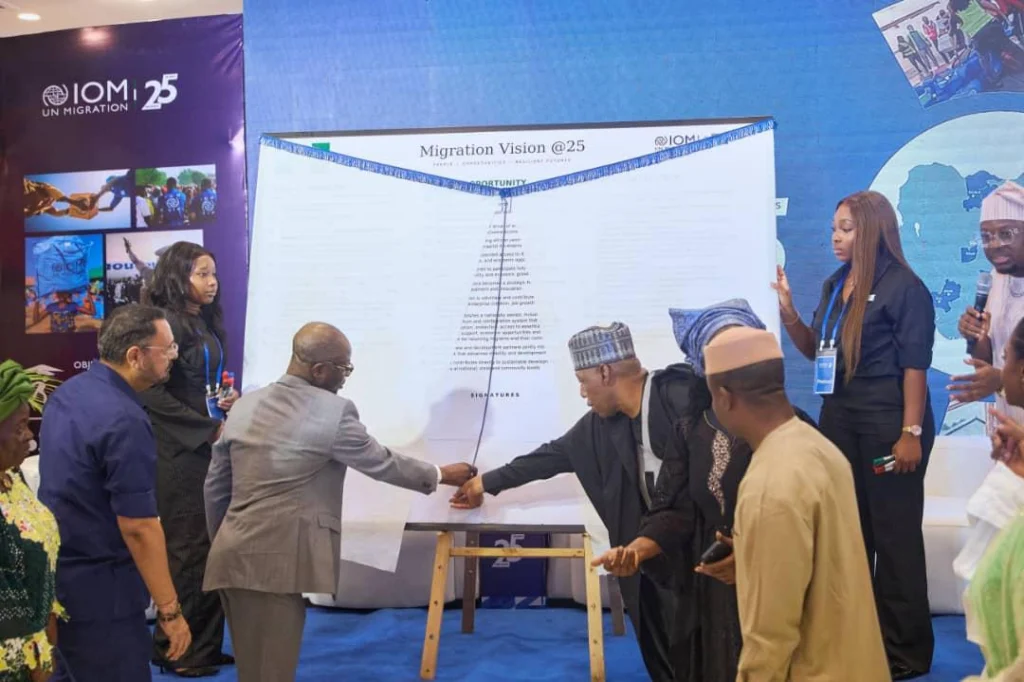
Nigeria, IOM face pressure to deliver jobs, lasting solutions for migrants
By Editor 
Nigeria faces mounting pressure to turn migration policies into economic opportunities, provide sustainable livelihoods for returning migrants and end dependence on short-term humanitarian assistance, as the Federal Government and the International Organization for Migration (IOM) marked 25 years of partnership.
The United Nations has warned that Nigeria risks failing to harness the potential of its youthful population unless it expands access to skills, decent employment and safe migration opportunities, cautioning that unemployment and exclusion could fuel instability, violence and recruitment into armed groups.
The warning came as the IOM disclosed that it had assisted more than 2.5 million people since 2014, supported nearly half a million displaced people with shelter and helped create or restore more than 75,000 jobs.
At the anniversary event in Abuja on Wednesday, government officials and development partners called for a shift from emergency interventions towards sustainable livelihoods, economic recovery and durable solutions for displaced communities and returning migrants.
The Minister of Humanitarian Affairs and Poverty Reduction, Dr Bernard Doro, said the government’s responsibility could not end with bringing migrants home without providing the conditions for them to rebuild their lives.
“The government’s responsibility must extend beyond bringing migrants home to providing them with opportunities for sustainable reintegration. The critical question is not how we bring our people home. It is what happens to them after they arrive,” he said.
The UN Resident Coordinator in Nigeria, Mohamed M. Malick Fall, said the country’s demographic advantage would only translate into economic growth if young people acquired the skills and opportunities needed to participate meaningfully in the economy.
He warned that demographic growth alone did not guarantee development, stressing that investments in education, skills, decent jobs and inclusion were essential to converting Nigeria’s large youth population into an engine of prosperity.
“Where young people see no pathway to a productive future, exclusion and unemployment can become fertile ground for instability, violence and recruitment into armed groups,” Fall said in his remarks marking IOM Nigeria’s 25th anniversary.
He argued that migration should not be viewed primarily as a crisis or security risk, but also as a potential driver of development when people could move safely, access employment and contribute their skills to the economies of their destination and home countries.
“When mobility is safe, regular and well-governed, it becomes a powerful development tool,” he said.
Fall said well-managed migration could connect workers to employment, help economies meet labour-market needs, promote knowledge exchange and stimulate innovation and investment.
He called for closer alignment between migration policies and Nigeria’s broader development priorities, including job creation, human capital development and economic growth.
“This is not simply a migration agenda. It is a development agenda. It is a jobs agenda. It is a human capital agenda. And ultimately, it is a sustainable development agenda,” he said.
The UN official urged the government, private sector, academia, civil society and development partners to work together to equip young Nigerians for emerging opportunities in agriculture, healthcare, digital services, manufacturing, renewable energy and other technology-driven sectors.
He said Nigeria’s future prosperity would depend on its ability to nurture talent and create pathways through which young people could compete and succeed locally, regionally and globally.
Zulum demands durable solutions for displaced people
The economic argument for sustainable livelihoods was reinforced by Borno State Governor, Prof. Babagana Zulum, who called on IOM to move away from predominantly short-term humanitarian interventions towards lasting solutions for communities affected by insurgency and terrorism.
Speaking on behalf of governors in the North-East, Zulum acknowledged the organisation’s support for people affected by the crisis since 2009 but argued that emergency relief alone could not resolve the underlying challenges of displacement.
“There is no humanitarian solution to our humanitarian crisis. Therefore, we want IOM to shift its focus largely from shorter-term, non-sustainable solutions to medium- and longer-term sustainable and durable solutions,” he said.
His position highlighted the need for interventions that would enable displaced families to rebuild their homes, restore their livelihoods and regain economic independence rather than remain dependent on humanitarian assistance.
The call comes amid growing pressure on humanitarian organisations to deliver more sustainable outcomes as needs rise and funding becomes increasingly constrained.
IOM’s Chief of Mission in Nigeria and the ECOWAS region, Sharon Dimanche, warned that the widening gap between humanitarian needs and available resources was threatening the ability of aid organisations to respond adequately to increasingly complex crises.
“We are operating in an environment that is increasingly challenged by limited resources. We are seeing a shrinking funding space amidst skyrocketing needs, climate shocks and climate pressures leading to more and more displacement,” she said.
Dimanche identified conflict, climate pressures and limited economic opportunities as factors contributing to displacement and encouraging young people to seek opportunities elsewhere.
She called for greater government and community ownership of migration programmes, stressing that investment in youth skills, safer migration pathways and stronger engagement with Nigerians in the diaspora would be critical to national development.
IOM reports millions assisted, thousands of jobs supported
Presenting the organisation’s record over the years, Dimanche said IOM had evolved from a small operation established in Lagos in 2001 with two staff members, limited resources and a small office space into one of its largest country operations worldwide.
She said the organisation now had an operational footprint across all 36 states and the Federal Capital Territory, reflecting the expansion of its partnership with Nigeria to address changing migration and humanitarian needs.
Since 2014, IOM has assisted more than 2.5 million people, supported nearly half a million displaced people with shelter, built or repaired more than 33,000 shelters and helped over 737,000 people access safe water, she said.
The organisation had also supported more than 2,000 small businesses, contributing to the creation or restoration of over 75,000 jobs.
Beyond direct humanitarian assistance, IOM had supported national migration frameworks, trained more than 6,500 government officials, strengthened border systems at 33 locations and provided data to guide emergency interventions.
Dimanche, however, said the organisation’s impact should not be measured solely by the number of people assisted or projects completed, but also by the extent to which its interventions enabled people to rebuild their lives and regain control of their futures.
“Saving lives is essential. But it is not enough,” she said, emphasising the need to help people acquire skills, earn a living and achieve lasting economic security.
She attributed the organisation’s progress to the trust established with the Nigerian government, communities, development partners and vulnerable migrants.
“For me, the greatest and biggest achievement is the trust. The trust with the Government of Nigeria, the trust with the people of Nigeria, the communities that we serve and the very vulnerable migrants,” she said.
Government unveils revised migration policy
Doro disclosed that the revised National Migration Policy and its implementation plan were approved on August 19, 2026, with provisions intended to clarify institutional responsibilities, establish measurable outcomes and improve the use of migration data for planning and reintegration.
Representing President Bola Tinubu, Ambassador Anthony Nnamdi Alonwu called for effective implementation of the National Migration Policy and the Global Compact for Migration, alongside stronger collaboration among the different levels of government.
He said migration remained a permanent feature of human society that could contribute significantly to national development when properly managed.
“We must therefore acknowledge human mobility as a permanent feature in our society which can address inequalities, provide options for individuals and their families,” he said.
Alonwu stressed the need to integrate migration into national planning, establish safer legal pathways and protect migrants from trafficking, exploitation and dangerous journeys.
The UN Resident Coordinator also called for recognition of skills and professional qualifications across borders, fair recruitment practices and mobility pathways that would allow workers to use their capabilities wherever opportunities existed.
The UN, he said, was committed to working with the Nigerian government and development partners to ensure migration contributed to inclusive growth, resilience and progress towards the Sustainable Development Goals.
IOM sets sights on 2051
Looking beyond its 25th anniversary, Dimanche outlined a shared vision for migration in Nigeria through 2051, built around three priorities: mobility, opportunity and resilience.
The vision seeks to create a country where Nigerians can migrate through safe and regular channels, access employment opportunities, transfer their skills across borders and return home to rebuild their lives with dignity.
It also envisages stronger protection against human trafficking and exploitation, better support for communities affected by conflict and climate shocks, and improved use of evidence in migration planning.
Dimanche said the ambition was to ensure that displacement became only a chapter in people’s lives rather than a permanent condition, while enabling young Nigerians, women, entrepreneurs and members of the diaspora to contribute more effectively to national development.
She urged the government and its partners to use the anniversary to commit to a more ambitious future.
Referring to children born in Nigeria in 2026, who would be 25 years old when the country and IOM mark 50 years of partnership in 2051, she challenged stakeholders to consider the opportunities and security those young people would inherit.
She said the future should be measured not only by projects delivered or people assisted, but by lives changed, opportunities created and communities empowered.
Representatives of the European Union and other development partners also emphasised the need for stronger migration policies, expanded legal migration pathways, investment in youth skills and improved protection of migrants’ rights.
As Nigeria and IOM enter the next phase of their partnership, the central test will be whether their commitments produce tangible results: safer migration, sustainable reintegration, viable livelihoods for returnees and durable solutions for displaced communities.
For a country seeking to turn its youthful population into an engine of economic growth, the challenge is no longer simply to manage the movement of people, but to ensure that migration expands opportunity, reduces vulnerability and gives more Nigerians a credible pathway to a productive future.

Comments