
By Maharazu Ahmed
Governor Dikko Umaru Radda enters the 2027 race as the favourite in Katsina State. He has the ticket, the government, the campaign council, and — on paper — the endorsement of every elected APC member in the state.
He, however, does not have a united party. The opposition is also getting stronger, bolder.
That is the contradiction at the heart of his campaigns in Funtua and Daura zones. The crowds were large. The scorecard was impressive. The endorsements were unanimous. But behind the stage, Katsina APC has split into two camps, and until that split is healed, no crowd can guarantee victory.
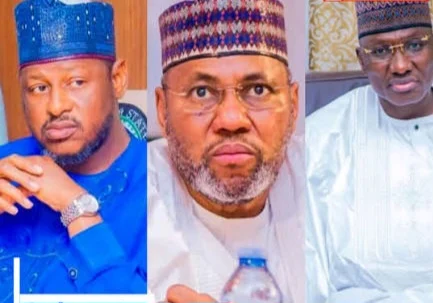
The division is openly between the “Katsina APC” and the “Katsina/Abuja APC.”” The first is the home-based party loyal to Governor Radda. The second is the Abuja-based network of Katsina politicians holding influential federal positions, led by Ibrahim Kabir Masari, Special Adviser to President Bola Tinubu on Political and Other Matters.
The division stems largely from a battle for influence and control between Dikko Radda, governor of Katsina State, and Masari. It has fractured the ruling party in the state into two opposing camps.
Radda himself has spoken publicly about forces working from Abuja to undermine his administration, saying he would expose them when the time is right.
Analysts warn this is not a quarrel at the top alone. It is more like an internal “civil war”, which if not contained, could split the APC votes.
How Billboards Became a Battle
The rift had been kept under wraps until August, when the governor’s ADC and CSO were arrested in Abuja over the alleged destruction of billboards bearing President Tinubu and Masari along Modoji Junction–Katsina Government House Road.
Masari, in a BBC Hausa interview published on November 16, said the crisis began when Radda’s camp erected billboards featuring the governor without Tinubu.
According to him, he and other federal appointees produced their billboards featuring Tinubu, Vice-President Shettima, Radda, and former governors Aminu Bello Masari and Ibrahim Shehu Shema.
He alleged that Radda’s ADC and CSO led youths at night to destroy those billboards but said he could not confirm whether the governor was aware or not. “But his Aide-de-Camp and the Chief Security Officer at the Government House led thugs at night to destroy the billboards.”
The dispute escalated again in November, when the governor’s CSO and ADC were re-invited by Force Headquarters in Abuja and were not seen in Katsina for days — including during the campaign in Daura Zone.
For voters watching, the symbolism was damaging – a governor campaigning on security is unable to protect his own closest aides from being taken away by police over a party quarrel.
Also, in early October, five key appointees resigned within days. They include the Commander-General of Hisbah, his deputy, the Chairman of the Pilgrims Board, and two senior aides. Sources linked them to Masari’s camp. Then came the removal of former Minister of Housing, Ahmed Musa Dangiwa, who belongs to the governor’s camp, from the Federal Executive Council. He was replaced by Mutaqa Rabe Darma, said to be loyal to Masari.
Masari says he tried repeatedly to meet Radda, even through the governor’s wife, but his calls were not returned. He also says he and his supporters were not invited to the launch of Radda’s re-election campaign despite being listed in the campaign council.
Yet he insists: “Dikko Radda has an excellent record of performance; his achievements are noticeable, and even his detractors can attest to his work, and I have never regretted my support for the governor.”
That sentence captures the tragedy of the split: the two men agree on Radda’s record but can not agree on who controls the party that must sell that record.
Funtua: Where the Split Hurts Most
Funtua Zone should be Radda’s safest ground. In 2023, he won 10 of its 11 local governments, polling 307,985 votes to the PDP’s 196,502.
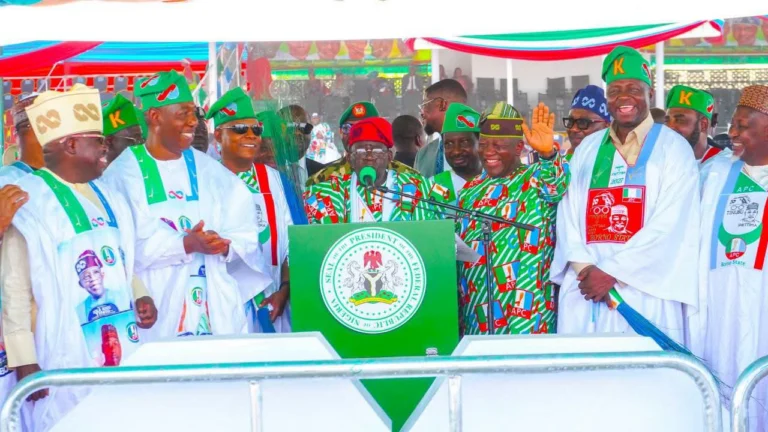
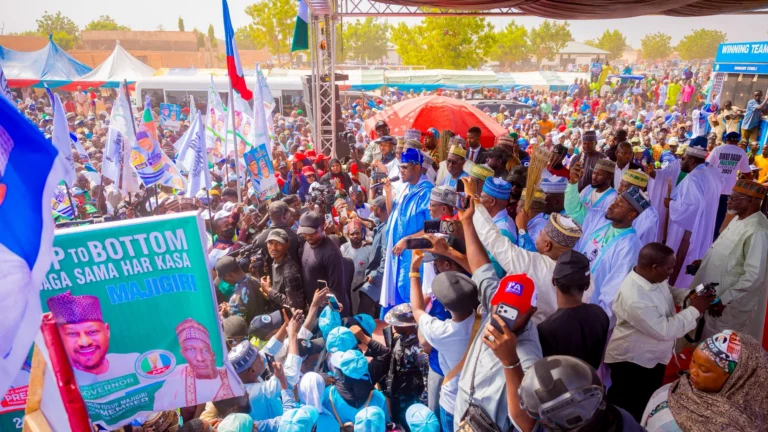
The 2027 tour of the zone from October 28 to November 8, was designed to show unity, including a consensus ticket, 1,070 projects, fertiliser at N25,000 per bag, hospitals commissioned in Faskari, Dandume and Danja, and roads in Bakori.
But Funtua is also where the APC’s internal war is most visible at the ward level. The consensus process that was supposed to prevent division has itself created bitterness. Aspirants who stepped down are still aggrieved. Ward leaders who feel sidelined are the same people who must deliver polling units.
In Faskari, Kankara, Bakori, and Malumfashi, where insecurity is worst, voters are not asking which faction is right. They are asking whether a party that can not settle its billboard quarrel can settle banditry.
The government claims a 70% reduction in banditry and N36.87 billion in security spending. But if the party’s own convoys are attacked as happened on the Yashe-Funtua road on October 28, with deaths reported and 14 arrested, and if the governor’s own aides are being questioned in Abuja while he campaigns, the claim rings hollow.
In Funtua, therefore, the danger is not just that voters will switch to the opposition in large numbers. It is also that APC voters, divided and demoralised, will simply stay home.
Daura: Legacy Divided
Daura was supposed to be the zone where the APC could hide its division behind Buhari’s legacy.
Party stakeholders in the zone have unanimously endorsed Radda, declaring that abandoning the APC would betray the late former President Muhammadu Buhari, who hailed from Daura
According to former APC National Legal Adviser Ahmad Elmarzuq, endorsing Radda was not just a political decision but a symbolic act aimed at preserving Buhari’s legacy.
But Daura is also one of Masari’s bases. If that network is not fully mobilised for Radda, the APC’s margin in Katsina North will shrink, even if Radda still wins the zone.
Daura is also where the opposition’s most dangerous local challenge comes from. Former DSS Director-General Lawal Daura, himself from Daura, who left the APC for the ADC and then moved to the Allied People’s Movement (APM) as the party’s vice pesidential candidate. His defection gives disgruntled APC members in Daura a home-grown alternative — not a stranger from another zone, but one of their own.
The Daura zone’s endorsement, therefore, was not just a celebration. It was a counter-move aimed at drawing a clear line between loyalty to Buhari’s party and the emerging ambitions of Lawal Daura.
The Opposition Crowds
The crowds that greeted the opposition in November should worry the APC.
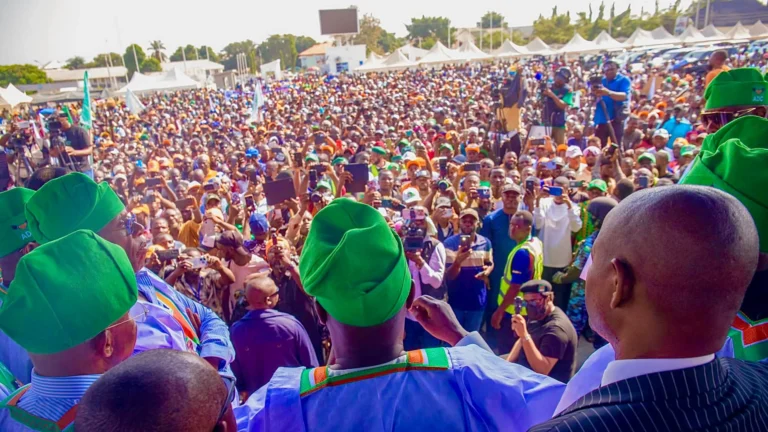
In Funtua, the ADC filled Aya Primary School for Senator Ahmad Babba Kaita’s flag-off, under the blunt slogan ‘ Tinubu/Dankoli Must Go and Falle Daya Ce’ — one term only, while in Katsina metropolis, the PDP shut down the stretch from Kofar Kaura roundabout to its state headquarters on IBB Way for Senator Yakubu Lado Danmarke, with supporters chanting ‘Sai mun canza’ — we will change the government.
Both crowds were real. Both carried the same message – this is not about projects. It is about hardship, insecurity, and the cost of living.
That is why they matter. They are proving that the anger in Katsina is organised, not just whispered in markets and motor parks. They have also broken the psychology of inevitability that Radda’s campaign has worked so hard to build.
Once voters see that thousands can openly gather against an incumbent in his own strongholds, staying home becomes less attractive, and defecting becomes less frightening.
In reality, a crowd is not a structure. The ADC still carries the wound of its disputed primary, with a rival claimant and court threats hanging over Kaita’s ticket and with Mustapha Inuwa back in the APC and Daura in APM.
There is also the PDP, which is more stable under Lado, and its promises on free education, free healthcare, and pension reform resonating with civil servants and retrenched workers. With a determined push, the PDP must move beyond its traditional strongholds by appealing to undecided voters.
For now, the opposition threat is conditional. If ADC and PDP split the protest vote between them, Radda may survive, even with a divided APC. But it will be a hell of a battle, especially if any of the opposition parties emerge as the single vessel for the people’s anger against the governor.
Tinubu’s Intervention
On Sunday, November 22, 2026, President Tinubu intervened directly in Lagos: “To my confidant and bulldozer, Alhaji Masari, go back home and reconcile with everybody. That is the order of the president.”
“Every anger must dissipate and evaporate.”
The intervention shows how serious Abuja now considers the Katsina crisis. A president does not publicly order reconciliation unless he fears the division could cost him votes — for himself as well as for the governor.
But an order is not a reconciliation. As analysts have warned, even though the APC in Katsina has been trying to conceal this rift, it is obvious that if this continues, it will seriously affect the party’s success in 2027.
This reconciliation will have to be measured not by handshakes, but by willingness of Masari’s camp to fully join the campaign, bringing back into the party, aggrieved aspirants and appointees who resigned, and the neutrality of security agents in the intra-party dispute.
Until these are addressed positively, he Tinubu/Dikko campaign will be running with one leg.
A divided APC facing a divided opposition does not guarantee an APC win — it guarantees a low-turnout, low-trust election where small shifts at the ward level decide everything.
For now, Radda still maintains a slim lead. He has the structures, the scorecard, and the incumbency. In Funtua and Daura, his campaign showed he can still fill a town square.
But structures without unity can not deliver. Whoever contains his own internal crisis first among the leading governorship candidates will have the upper hand in February 2027.
In 2023, Radda won because the APC was the party that could unite Katsina. In 2027, he may lose votes not because voters have rejected his record but because his party has rejected itself.
The Funtua and Daura tours proved he can campaign. They have not yet proved he can reunite, which, more than any opposition candidate, is the election he must win first.
Comments