
By Bagudu Mohammed
In the university, I took a course in international relations and found it very fascinating. In all the IR courses I took, I got an A, to tell you how much I enjoyed them. All the textbook theories and fascinating ideas about diplomacy, which is the core function of a foreign mission, come flooding back to mind when I watch the High Commissioner to South Africa, Femi Fani-Kayode, trend in his normal attitude of social media combatant, engagement, aggression, brute force and raw punches as a tool of diplomacy.
True, I feel the comment, do not disgrace your country, directed by South African officials at our own High Commissioner, was avoidable and truly provoked. But provocation does not excuse a diplomat for forgetting what diplomacy is.
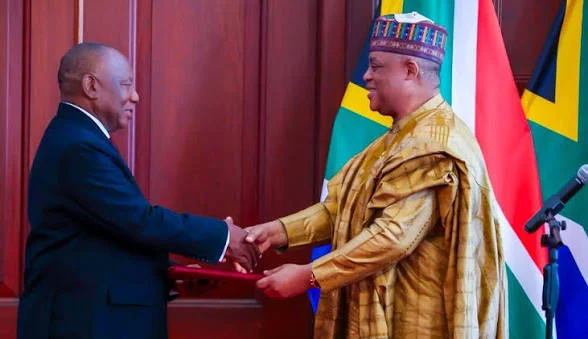
A diplomatic dispute has escalated between the South African Presidency and the Nigerian High Commission in Pretoria following a public disagreement over the omission of High Commissioner Fani-Kayode’s remarks from a live broadcast during a formal credential presentation ceremony. The controversy originated at the Sefako M. Makgatho Presidential Guest House in Tshwane, where President Cyril Ramaphosa received letters of credence from fifteen newly accredited foreign envoys.
Fani-Kayode protested that while the introductions and speeches of the other fourteen ambassadors were aired uninterrupted, the livestream was cut off during Nigeria’s segment and resumed only after he had concluded his address. Following the envoy’s complaint, the South African Presidency published a separate recording of his speech on its official YouTube channel.
Fani-Kayode subsequently stated that he raised the issue directly with Ramaphosa during a post-ceremony photograph session, claiming the South African leader summoned broadcast officials to rectify the omission. Responding publicly on the social media platform X, Ramaphosa’s spokesperson, Vincent Magwenya, refuted the assertion that the President had intervened in the broadcast, describing the Nigerian envoy’s public approach as inappropriate and urging him to engage constructively with South African institutions.
Your Excellency, I deeply regret that I have to address you through a public platform, Magwenya wrote, however, now that you have falsely referenced the President on a matter he has no involvement in, I am duty bound to clarify your misrepresentation of facts. In South Africa the President does not intervene on operational matters at the public broadcasters, neither did he intervene on your behalf. He simply pointed you to Sophie Mokoena who was the most appropriate person to raise your grievance with.
Magwenya added that Fani-Kayode had declined to speak with South African Broadcasting Corporation Foreign Editor Sophie Mokoena to resolve the technical misunderstanding, emphasizing that the South African head of state holds neither the legal authority nor the political mandate to interfere in the editorial or operational decisions of the public broadcaster.
In a counter-statement issued via its official X account, the Nigerian High Commission stood by its envoy, insisting that both Fani-Kayode and Nigeria had been subjected to unfair treatment and maintaining that Ramaphosa had indeed stepped in to resolve the matter. Our Ambassador, Chief Femi Fani-Kayode, was treated with contempt and disdain and by extension so was Nigeria, the mission stated.
The High Commission’s statement prompted a sharp rejoinder from Magwenya, who dismissed the mission’s account as false and urged Nigerian diplomatic officials to familiarize themselves with South Africa’s constitutional framework and broadcasting regulations. Even when it is institutionalised, a lie remains a lie, Magwenya replied. There was no such intervention from the President or the Presidency and there will never be. Read our constitution and laws and familiarise yourself with the SABC editorial code. Stop disgracing yourself and your country.
It is not merely a disagreement over a livestream. It is a textbook case of how a diplomat can damage the very country he was sent to represent, by confusing visibility with influence, and noise with power. Fani-Kayode acted less like a High Commissioner and more like a social media combatant, and that is precisely the problem.
In international relations, there is a clear distinction between diplomacy and megaphone diplomacy. Classical diplomacy, from the Congress of Vienna in 1815 to the Vienna Convention on Diplomatic Relations in 1961, is built on quiet negotiation, discretion, protocol, and respect for the host state.
Megaphone diplomacy is its opposite, taking a grievance to the press or social media to embarrass the other side and win applause at home.
Liberal institutionalism, associated with Robert Keohane and Joseph Nye, argues that international order survives because states build and respect institutions, rules, and norms, even when it is inconvenient. South Africa’s spokesperson made an institutional point that Fani-Kayode ignored. In South Africa, the President does not intervene in the operational decisions of the SABC. The SABC has an editorial code. The President has neither the legal authority nor the political mandate to order a broadcaster around.
Whether Fani-Kayode liked that answer or not, that is South Africa’s constitutional framework. A diplomat’s job is to understand the host country’s system, not to import his home country’s expectations into it.
Joseph Nye’s theory of soft power is crucial here. Hard power is coercion, sanctions, and military force. Soft power is attraction, credibility, culture, and moral authority. A country like Nigeria, which wants investment, respect for its diaspora, and influence in the African Union, depends enormously on soft power. South Africa hosts one of the largest Nigerian diasporas in Africa. Nigerians there face xenophobia, police harassment, visa difficulties, and business discrimination. Who is supposed to quietly negotiate those issues?
Constructivist scholars like Alexander Wendt argue that anarchy is what states make of it, meaning that a country’s reputation is socially constructed by how it behaves repeatedly. Nigeria is constantly fighting the stereotype of being loud, chaotic, and undisciplined. Fani-Kayode performed that exact stereotype on the world stage. He confirmed the bias he was supposed to disprove. The South African Presidency did not need to insult Nigeria. The Nigerian envoy gave them the material to do it. A good ambassador constructs a different identity, calm, competent, principled, and formidable behind closed doors. A bad ambassador confirms the worst story others already tell about his country.
Daniel Goleman’s work on emotional intelligence adds another layer. Self-awareness, self-regulation, empathy, and social skill are not soft ornaments in diplomacy. They are the operating system. A man who cannot regulate his anger over a livestream cannot regulate a crisis over xenophobic attacks, trade disputes, or the arrest of Nigerian citizens.
Leadership in diplomacy is not about who lands the last punch on X. It is about strategic restraint. Think of the great diplomats, Kofi Annan, Nelson Mandela’s envoys, or even Nigeria’s own Jaja Wachuku and Okoi Arikpo. Their power lay in what they did not say in public. They understood what the Chinese strategist Sun Tzu meant, that the supreme art of war is to subdue the enemy without fighting. The supreme art of diplomacy is to win the correction without creating a crisis.
I expected Femi Fani-Kayode to have learned, to have become more refined and modest, from the alleged news of his rejection when he was posted to Germany by President Tinubu in March earlier this year. Yet it is not even long since he was posted to South Africa and it is already proving his critics and cynics right.
It is that Fani-Kayode may not have justification for his conduct like many other cases of overreaction or violence. In fact, even criminals like bandits and kidnappers tend to believe they have justification for their actions. So what makes a real difference is how we handle issues.
Incidentally, while emotional intelligence and diplomacy could be seen as a personal moral choice to ignore or despise, to handle issues unconventionally by one’s own way, fani- kayode now occupies a position that demands such emotional intelligence, diplomacy, and restraint in leadership approach as a matter of protocol and tradition.
An ambassador is not a social media influencer. He is not a party spokesman. He is the personification of his Head of State in a foreign capital. When he disgraces himself, he does not disgrace himself alone. He lends his country’s flag to his personal quarrel.
I understand that people like Femi Fani-Kayode, Daniel Bwala, Nyesom Wike, Dino Melaye, and Kenneth Okonkwo must have believed that they tend to make a living, survive, or progress from loose mouth, loud noise, brute punches, and aggressive reactions that they have internalised. Recall that Femi Fani-Kayode was once a campaign spokesperson for Goodluck Jonathan and eventually became a verbal, violent defender of Bola Ahmed Tinubu, which has earned him his current appointment to be proud of.
The tragedy is that the skill that wins a campaign is not the skill that wins a negotiation. Harold Nicolson, in his classic work on diplomacy, warned that the diplomat must be truthful, precise, calm, patient, modest, and loyal, and that the temptation to be clever, theatrical, or popular is the beginning of failure.Campaigning rewards the punch. Diplomacy rewards the pause. One builds a crowd. The other builds a country.
However, when people who should call us Sir, Your Excellency, Your Highness, begin to call us out to not disgrace our country, it is the citizens of that country, with dignity and sensitivity, who may be most affected, needing to cover their eyes for the embarrassment and shame. That is why Magwenya’s rebuke, however harsh, stung. It exposed the difference between diplomacy as a profession and diplomacy as performance.
And it leaves us with a haunting question. If the man sent to defend Nigerians in South Africa cannot defend Nigeria’s dignity in a dispute over a video, who will defend Nigerians when the dispute is over life itself?
Bagudu Mohammed is the founder of Alternative Perspectives, a widely read commentary platform on social media, and writes a weekly newspaper column published every Monday on the back page of Peoples Daily.Web: https://alternativeperspective.onrender.com
Comments