ABUJA — If federal allocations stopped today, most Nigerian states would struggle to pay salaries, run government, and service debts beyond next week, according to the 2026 State of States Report released by civic-tech organisation BudgIT.
The report, titled “From Allocation to Impact: Rethinking State Spending Priorities,” assesses the fiscal performance of 35 states in 2025. Its Fiscal Viability pillar measures whether a state can fund public salaries, overheads, and debt obligations from its own revenue, while managing demands on its total income.
States that rank higher, BudgIT said, demonstrate “a comparatively stronger capacity to manage their expenditure obligations within the limits of their available revenue.”
Enugu leads, Bayelsa second
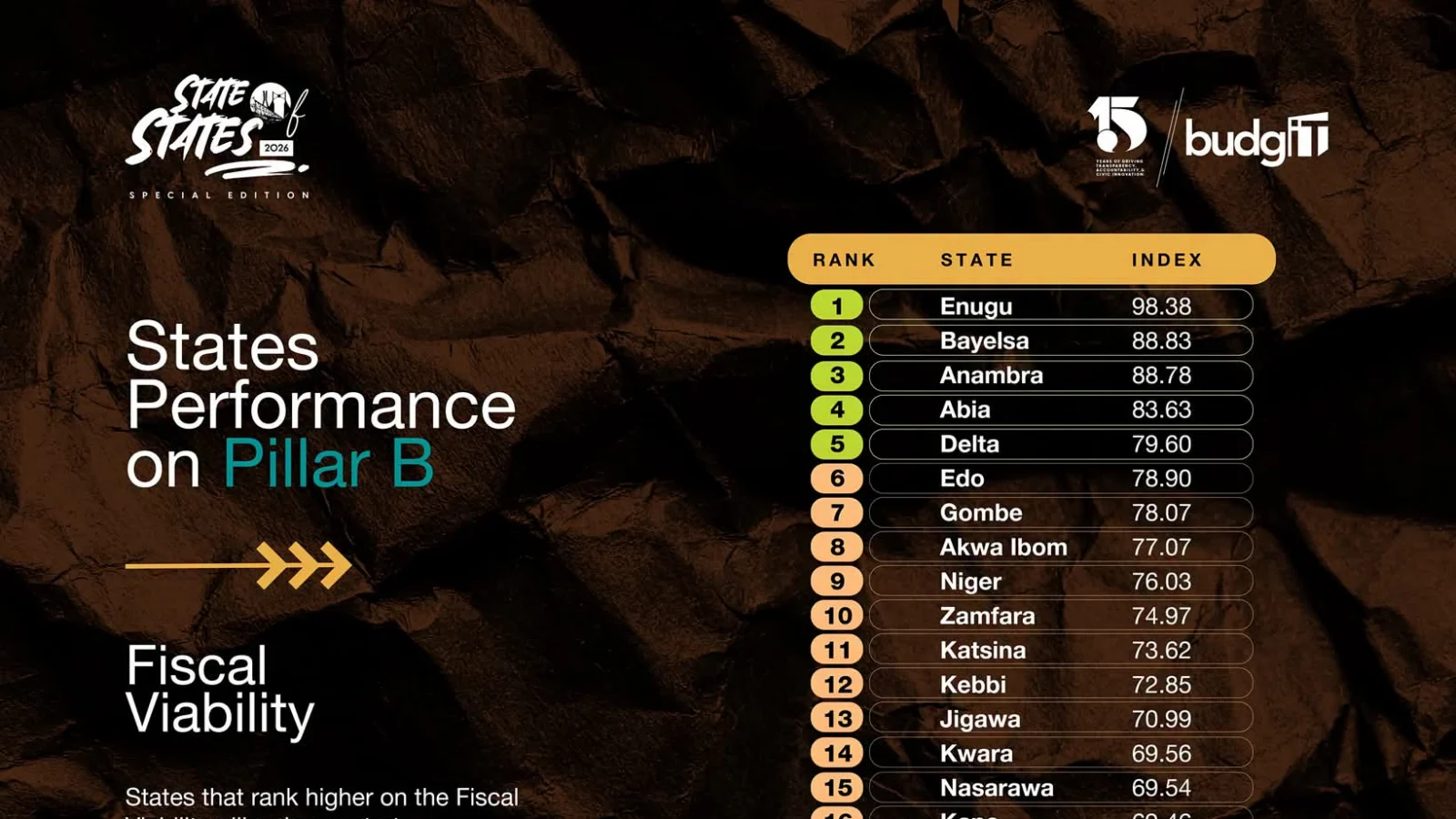
Enugu emerged number one in Fiscal Viability with a score of 98.38 per cent, followed by Bayelsa with 88.83 per cent.
Anambra, Abia, and Delta completed the top five, recording some of the strongest performances in managing expenses with the revenue available to them.
Middle pack told to cut cost of governance
A large group of states landed in the middle of the ranking, including Edo, Gombe, Akwa Ibom, Niger, Zamfara, Katsina, Kebbi, Jigawa, Kwara, Nasarawa, Kano, Lagos, Imo, Kaduna, Taraba, Ondo, Borno, Ebonyi, Oyo, Osun, Ekiti, Adamawa, Bauchi, Cross River, and Ogun.
BudgIT said those states still have room to improve, particularly in managing the cost of running government. Zamfara, for instance, placed 10th on the index with 74.97 per cent.
Bottom five face urgent pressure
At the bottom end are Sokoto, Benue, Yobe, Plateau, and Kogi, occupying the last five positions.
The report suggests those states have significant catching up to do in aligning their spending with the revenue coming in.
The findings have renewed questions for governors who argue that states need more money to function. BudgIT is urging citizens to instead ask how well the money already received is being managed.
The full 2026 State of States Report is available on BudgIT’s website.


Comments