

GOV NAMADI: PREVENTING MALNUTRITION IS CRITICAL TO BUILDING A HEALTHY AND PRODUCTIVE POPULATION
By Ali Baba-Inuwa
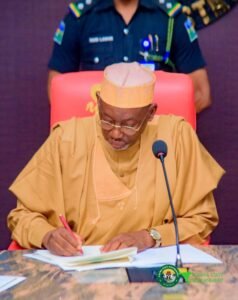
Gov. Umar Namadi has said that preventing malnutrition, particularly among children, is essential to building a healthy, productive population and achieving sustainable human capital development.
He made this assertion while receiving a delegation of Commissioners of Budget from the 19 Northern States and representatives of the Food and Agriculture Organization of the United Nations (FAO), led by Mrs. Clementina Okoro, Director of Food and Nutrition at the Federal Ministry of Budget and Economic Planning, during a courtesy visit to Government House, Dutse, on Monday.
The delegation was in Jigawa State for a three-day zonal review meeting on Nigeria’s Food Systems Transformation Pathways, aimed at assessing progress, sharing experiences, and strengthening coordination among states towards the implementation of the national strategy.
Speaking to the delegation, Governor Namadi expressed appreciation for the choice of Jigawa State as the venue for the meeting, describing food systems transformation as an area of considerable interest to his administration.
Agricultural development, he said, must go beyond food production to comprise the entire value chain, including processing, value addition, transportation, and final consumption, particularly emphasizing the need to prioritize preventive measures against malnutrition.
“Our priority should be prevention. We should not wait until malnutrition reaches a stage where curative intervention becomes necessary. We must put appropriate measures in place to prevent it from occurring in the first place,” he said.
He described nutrition as a critical component of human capital development, adding that a healthy and well-nourished population was fundamental to sustainable progress.
“Human capital is fundamental to development. Without a healthy and productive population, achieving progress becomes difficult. For us to build a capable and productive human resource base, we must ensure that our children are healthy and adequately nourished.”
Governor Namadi called for a systematic approach to addressing malnutrition, involving the identification of appropriate interventions, the levels at which they should be implemented, and the right time for their delivery.
He assured the delegation of the state government’s continued support for the initiative, noting that although the strategy was being coordinated at the national level, its ultimate benefits would be felt by citizens across the states.
“I therefore assure you that the Jigawa State Government will support your efforts and continue to encourage the work you are doing. Although the initiative involves collaboration at the national level, its ultimate benefits will be felt by our people across the states.”
Speaking earlier, the leader of the delegation, Mrs. Clementina Okoro, explained that the zonal review meetings were designed to cover all 36 states and the Federal Capital Territory, with regions grouped according to their geopolitical zones to ensure inclusive participation.
Mrs. Okoro commended the Jigawa State Government for its hospitality and expressed satisfaction with the presentations and initiatives shared during the review meeting.
She particularly highlighted the state’s homegrown solutions, including the Masaki Programme, describing the reported interventions as encouraging examples of efforts to improve food systems and nutritional outcomes.
“Food systems transformation cuts across various sectors, ranging from agriculture, which deals with production, through processing,” she said.
She stressed the importance of involving women, young people, and small and medium-sized enterprises in the food value chain, saying their participation would promote value addition, create economic opportunities, and help address post-harvest losses, which remain a major challenge in the country.
She further noted that the delegation had received encouraging reports from participating states on efforts to strengthen nutrition financing through increased budgetary allocations, approvals, and releases.